
Teaching
My approach to teaching stems from my belief in the social and intellectual value of history, and my commitment to empathetic, open-minded, and rigorous pedagogy. As a historian, I think a fundamental understanding of the past is crucial to help people make sense of today’s political and cultural debates. I want students to appreciate the relevance of history to their present—after all, if history is not important, as some say, why does so much contemporary political debate circle on interpretations of past events? Moreover, in a world saturated by online disinformation, a rigorous grounding in history helps people grow more sophisticated in detecting the many distorted versions of the past that are routinely promulgated by malevolent political actors.
I also believe strongly that my subfield, environmental history, offers the chance for students to look at the past in a way that they are not likely to have encountered before. As the impacts of climate change accumulate around us and we remain largely politically inert, probing the history of human interaction with the environment could not be more important. Orienting history around environmental use, abuse, access, and dispossession allows students to see another aspect of power in action. After all, one of the greatest indicators of power is who has land and resources, and who can and cannot avoid living in insalubrious or barren environments.
More below on recent course offerings (syllabi available upon request)!

HIST 360:
Global Environmental History
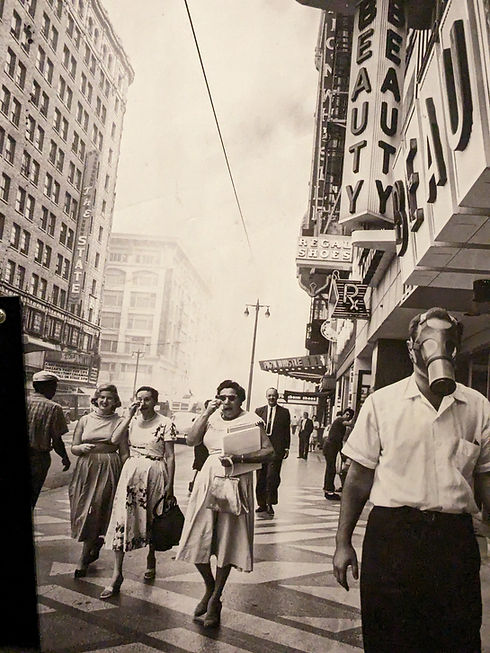
This course explores global environmental history with specific focus on the environmental changes and challenges of the last 125 years. In many ways, the world of 1900 would be unrecognizable to us, such has been the technological change and mass access to consumer goods of the intervening years. In this class, we explore the costs and benefits of widespread industrialization, the emergence of the automobile and commercial air travel, accelerated consumerism and garbage production, the silicon revolution of computers and artificial intelligence, and much more. We also examine modern environmentalism and anti-environmentalism and the success and shortcomings of international efforts to curb environmental harms.

HIST 299:
The History of the American West in the Long Nineteenth Century
This course investigates the reality and mythos of the American West in the long nineteenth century. As United States settlers expanded westward in the nineteenth century, violently dispossessing the Indigenous and Hispanic peoples they encountered, the West became a potent political and cultural symbol as well as a vast storehouse of the natural resources that would power the United States to global hegemony. Ever since the famous nineteenth-century Frederick Jackson Turner thesis of American history, historians have been captivated and conflicted by the American West's role in the broader history of the United States.
The general public has been equally captivated, too, but the popular memory of the American West has often been significantly removed from historical reality. For many, it was the “Wild West,” a place of supposedly few or arbitrary rules, far from the level of social control that prevailed in the east. The movie and novel genre of the “Western” has done much to create and reinforce this image. Yet the history, settlement, and growth of the American West was often heavily impacted by decisions made by the central government in Washington, DC. As often as not, the West has been a place of coercion and control, not freedom, abandon, or lawlessness. This course thus asks students to wrestle with complex historiographical debates and socio-political legacies along with facile but popular cultural narratives.

HIST 421:
Carbon Civilization: The Past, Present, and Future of Fossil-Fueled Society
This course tracks humanity’s emergence as an impactful, and often destructive, planetary force with special focus on the last two centuries. It familiarizes students with the techniques and major concerns of environmental and climate history and offers ways to think historically about our current era of accelerating ecological destruction and planetary uncertainty. This course prompts us to think about “energy regimes,” the Industrial Revolution (if this is even a singular thing), and climate change as significant drivers of history, among other phenomena.
Equally importantly, we will discover that environmental history widens the frame of historical actors, not merely historical analysis. Environmental historians and historians of allied disciplines have argued for the agency and importance of nonhuman animals in history, and that of even more inert aspects of the world around us: plants, forests, diseases, glaciers, entire ecosystems, and even the “Earth system” of climatic regulation. Environmental history is also an excellent lens for assessing power and inequality within human societies too. Natural resources are not evenly consumed worldwide, while environmental harms are disproportionately borne by those with the least political and economic power.
Above all, this course asks students to meditate on complex ideas which are at the heart of modern life: the relationships between control of natural resources, proximity to environmental hazards, and political power; the tensions and trade-offs between Westerners’ unparalleled standards of living and unparalleled consumptive habits; and the question of how we can live within the environmental limits of the planet and yet maintain and widen the material prosperity that so many of us enjoy.

HIST 545:
Historical Methods and Approaches
This class focuses on the mechanics of academic history. Academic historians use evidence – that is, primary sources – to assess the meaning of past events. They then contextualize that meaning relative to previous academic interpretations of events and eras, revising in some way our collective understanding of the past. This process is not easy, and this course is designed to help junior scholars plan, conduct, and articulate their research for maximum success. It also offers suggestions for navigating common difficulties along the research pathway.
We focus on obtaining and evaluating primary sources, designing a project, formulating research questions, arriving at an argument, and professional ethics and norms. We will discuss some major historiographical paradigms, but this course is less about theory and more about practice. To that end, we also interrogate the nature of "knowledge work" and how best to produce it.